I would like to take this moment to honor Mrs. Michelle Obama as the inaugural person in my new feature Melanade. This feature’s goal is to illuminate women of color who exemplify greatness in this world and who use their power for the betterment of women kind. Though I do not claim to be a feminist, I surely am one in my own way, because I admire and uplift women who make life easier for the next woman.
Flawless FLOTUS, that’s the name I dubbed Michelle Obama when she officially took office way back in 2009. I cannot tell you how overjoyed I was to see a strong, yet demure independent woman with brown skin and the grace of a dancer, move into the White House. She is so beautiful, but she also down to earth. She makes you feel as if you could be her good friend and not…
Regarding your fridge, is it organized or a mess inside?
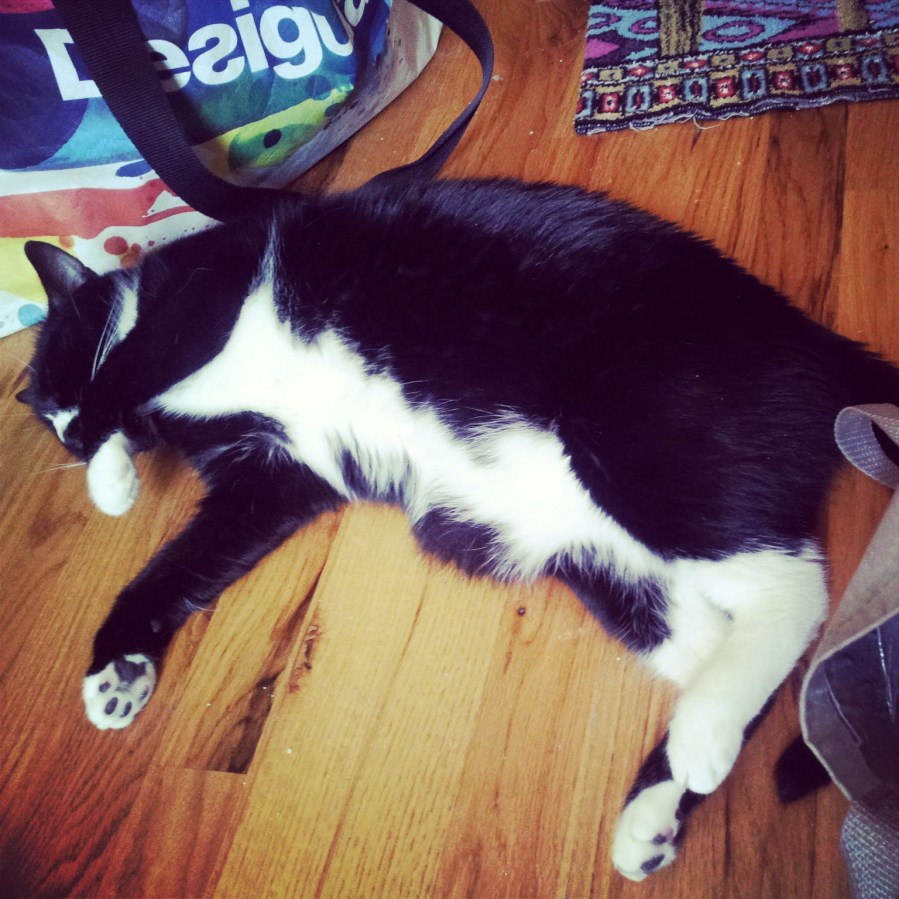
Being that both my room-mate and I are single there is very little in the fridge, unless my room-mate has one of his dinner parties and unlike the photo Sylvester does not get inside the fridge. Usually our fridge contains condiments, yogurt, Snapple, maybe beer or wine, and some leftover Chinese food, but again no cat.
Do you prefer your food separated or mixed together?
I suppose you are referring to the fridge. Since there is very little inside it does not make much difference. If however you mean on my plate I prefer to keep my foods separate not mixed together.
Do you prefer reading coffee table books (picture), biographies, fiction, non-fiction, educational?
I suppose I pretty much like all types of books unless they are too technical or involve romance. I don’t like romance books. Way too creepy, stupid, corny and unrealistic. My favorite genres are Horror, Murder Mysteries, History and some Sci Fi.
Close your eyes. Listen to your body. What part of your body is seeking attention? What is it telling you?
Pretty much all of my body is telling me to sleep. I’m a sleep deprived insomniac.
Optional Bonus question: What are you grateful for from last week, and what are you looking forward to in the week coming up?
Being that the U.S. is in political and social upheaval I suppose I’m glad to have gotten through the week. The Muslim Ban has gravely and adversely affected my Muslim co-workers and the functions of my museum workplace. Basically people are living in fear and uncertainty. Given that you don’t know what horror will next come out of the Oval House it’s best not to look forward. America is in total chaos. We are on extremely shaky ground.
An idea for this post came while I was riding the subway home. Suddenly the scents, smells, odors and fragrances of my childhood visits to Coney Island and Rockaway Playland came back to me. In a moment while I was riding on the funky L train I could actually smell, the surf, sand, the ocean and of course those World Famous Nathan’s Hot Dogs!!
Of course outside of New York Coney Island is probably the better known of the two. I remember my paternal cousins used to live in Brooklyn and when I got old enough to ride the bus from Queens into Brooklyn by myself I would visit them, making friends with their friends. One Coney Island memory stands out from all the rest. I was about 15 and I was hanging out with this boy (I was not allowed to date and I doubt I told my parents I was spending time with a boy!!) Anyway we played handball. I sucked but he put up with me and at some point we went to Coney Island. At some point he wanted to ride the famous Coney Island Cyclone roller-coaster. Now this is after we had been chowing down on hot dogs and other food! Well I finally gave in to his entreaties and on we went. Needless to say the Cyclone did not agree with me and all the food I had previous eaten was then forcibly ejected from my body. Even though the wild ride on the Cyclone had stopped my digestive system went into volcano mode with lunch becoming a memory littering the ground! I think at that point the fellow felt bad but other than that disaster over all I had a nice time.
Of course over the years I have been back to Coney Island many times but have avoided the Cyclone and ALL Roller Coasters at any venue including Six Flags!! Can’t stomach them!!
Now my brother Stephen on the other hand is totally different from me. He LOVES Roller Coasters and that includes the ones where you are suspended by a harness with your legs flying free in the breeze!! Strange how two siblings can have such different tastes!! LOL!!
Luna Park is the name of an amusement park in the neighborhood of Coney Island, Brooklyn in New York City that opened on May 29, 2010 at the former site of Astroland, an amusement park that had been in operation for 46 years.
Another great Coney Island event which I hope to attend this year is the Annual Mermaid Parade. After all I’ve been living in Brooklyn since the end of 2012 and have not made it out to the parade. Now where or not I will dress up as a Mermaid depends upon my mood and the weather as we get closer to June. I should just go ahead and order a Mermaid Costume perhaps in April. Now that will be something because I have never seen a Black Mermaid! So I may be the first African-American Mermaid unless some other Beautiful Sister has beat me to the punch.
My most vivid beach memories are of Rockaway Playland which consisted of not only the beach but arcade games that were fun to play. Go with your boyfriend or husband and get them to win one of those gigantic stuffed animals for you. Or compete with your beloved, family and friends to see whose is the fastest and who has the best aim to hit those targets!!
By the 1970s my cousins had moved to an apartment development called Bay Towers so I spent plenty of time with family, walking along the board walk and allowing the sand to sift between my toes. No Swimming because basically nobody in my family can swim!! That may have changed now since Stephen’s Residence takes him to the YMCA for swimming however I never conquered my fear of having my head underwater so I will let Stephen take the lead on this activity!
One summer beach vacation with me, Stephen, Our Dad were walking along the Boardwalk and this was the Summer Jam for 1974!! Whenever I hear this song immediately it takes me back to the Summer of 74 and Rockaway Playland!!
This New York Times article is from last year Feb. 2016 but still relevant and well worth a reprint.
New York Today: Celebrating Black History
Photo
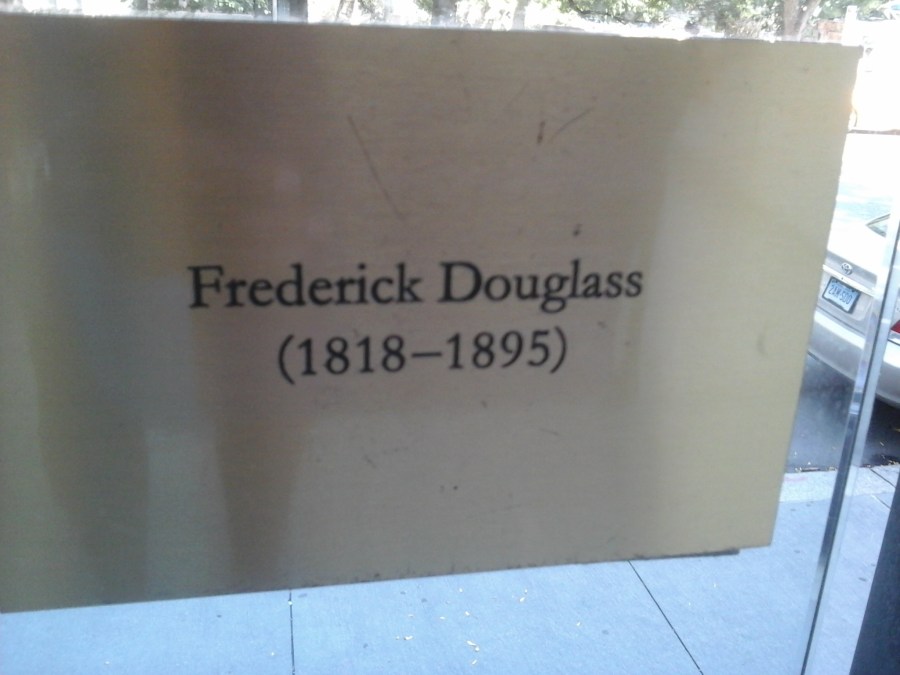
The Frederick Douglass Memorial at the northwest corner of Central Park.CreditMichelle V. Agins/The New York Times
Updated at 9:30 a.m. Feb. 2016
Good morning on this gray Monday.
When Frederick Douglass reached New York in 1838, after narrowly escaping the clutches of slavery, he wrote in a letter to a friend, “I felt as one might feel upon escape from a den of hungry lions.”
Today, an eight-foot bronze sculpture of Mr. Douglass stands on the northwest corner of Central Park, along a boulevard named after him.
Indeed, New York has long been a hub of black life in America, from the Harlem Renaissance to the elections of Adam Clayton Powell Jr. and Shirley Chisholm, and the city is rich with monuments, events and exhibits celebrating that history.
As Black History Month begins today, here are a few things worth exploring:
• At the Arsenal in Central Park, the Ebony Society presents an exhibition on the legacy of African-American public service.
As always, the Schomburg Center in Harlem has a large array of panels and lectures. This month’s selection includes discussions on teaching about slavery in New York, on the art of Jean-Michel Basquiat and on the Black Lives Matter movement.
Regardless of what you choose, kick off the month with “Harlem,” the poem by Langston Hughes, who was born on this day in 1902.
And be sure to explore a new compilation of unpublished photos of black history from the New York Times’s archives.
Abolitionist leader Frederick Douglass was born into slavery sometime around 1818 in Talbot County, Maryland. He became one of the most famous intellectuals of his time, advising presidents and lecturing to thousands on a range of causes, including women’s rights and Irish home rule. Among Douglass’s writings are several autobiographies eloquently describing his experiences in slavery and his life after the Civil War, including the well-known work Narrative of the Life of Frederick Douglass, an American Slave. He died on February 20, 1895.
Life in Slavery
Frederick Augustus Washington Bailey was born into slavery in Talbot County, Maryland, around 1818. The exact year and date of Douglass’s birth are unknown, though later in life he chose to celebrate it on February 14. Douglass initially lived with his maternal grandmother, Betty Bailey. At a young age, Douglass was selected to live in the home of the plantation owners, one of whom may have been his father. His mother, an intermittent presence in his life, died when he was around 10.
Frederick Douglass was eventually sent to the Baltimore home of Hugh Auld. It was there that Douglass first acquired the skills that would vault him to national celebrity. Defying a ban on teaching slaves to read and write, Auld’s wife Sophia taught Douglass the alphabet when he was around 12. When Auld forbade his wife’s lessons, Douglass continued to learn from white children and others in the neighborhood.
It was through reading that Douglass’s ideological opposition to slavery began to take shape. He read newspapers avidly and sought out political writing and literature as much as possible. In later years, Douglass creditedThe Columbian Orator with clarifying and defining his views on human rights. Douglass shared his newfound knowledge with other enslaved people. Hired out to William Freeland, he taught other slaves on the plantation to read the New Testament at a weekly church service. Interest was so great that in any week, more than 40 slaves would attend lessons. Although Freeland did not interfere with the lessons, other local slave owners were less understanding. Armed with clubs and stones, they dispersed the congregation permanently.
With Douglass moving between the Aulds, he was later made to work for Edward Covey, who had a reputation as a “slave-breaker.” Covey’s constant abuse did nearly break the 16-year-old Douglass psychologically. Eventually, however, Douglass fought back, in a scene rendered powerfully in his first autobiography. After losing a physical confrontation with Douglass, Covey never beat him again.
Freedom and Abolitionism
Douglass tried to escape from slavery twice before he succeeded. He was assisted in his final attempt by Anna Murray, a free black woman in Baltimore with whom Douglass had fallen in love. On September 3, 1838, Douglass boarded a train to Havre de Grace, Maryland. Murray had provided him with some of her savings and a sailor’s uniform. He carried identification papers obtained from a free black seaman. Douglass made his way to the safe house of abolitionist David Ruggles in New York in less than 24 hours.
Once he had arrived, Douglass sent for Murray to meet him in New York. They married on September 15, 1838, adopting the married name of Johnson to disguise Douglass’s identity. Anna and Frederick settled in New Bedford, Massachusetts, which had a thriving free black community. There they adopted Douglass as their married name. Frederick Douglass joined a black church and regularly attended abolitionist meetings. He also subscribed toWilliam Lloyd Garrison‘s weekly journal The Liberator.
Eventually Douglass was asked to tell his story at abolitionist meetings, after which he became a regular anti-slavery lecturer. Garrison was impressed with Douglass’s strength and rhetorical skill, and wrote of him in The Liberator. Several days after the story ran, Douglass delivered his first speech at the Massachusetts Anti-Slavery Society’s annual convention in Nantucket. Crowds were not always hospitable to Douglass. While participating in an 1843 lecture tour through the Midwest, Douglass was chased and beaten by an angry mob before being rescued by a local Quaker family.
At the urging of Garrison, Douglass wrote and published his first autobiography, Narrative of the Life of Frederick Douglass, an American Slave, in 1845. The book was a best seller in the United States and was translated into several European languages. Although the work garnered Douglass many fans, some critics expressed doubt that a former slave with no formal education could have produced such elegant prose. Douglass published three versions of his autobiography during his lifetime, revising and expanding on his work each time. My Bondage and My Freedom appeared in 1855. In 1881, Douglass published Life and Times of Frederick Douglass, which he revised in 1892.
Following the publication of his autobiography, Douglass traveled overseas to evade recapture. He set sail for Liverpool on August 16, 1845, and eventually arrived in Ireland as the Potato Famine was beginning. He remained in Ireland and Britain for two years, speaking to large crowds on the evils of slavery. During this time, Douglass’s British supporters gathered funds to purchase his legal freedom. In 1847, the famed writer and orator returned to the United States a free man.
Upon his return, Douglass produced some abolitionist newspapers: The North Star, Frederick Douglass Weekly, Frederick Douglass’ Paper, Douglass’ Monthly and New National Era. The motto of The North Star was “Right is of no Sex – Truth is of no Color – God is the Father of us all, and we are all brethren.”
In addition to abolition, Douglass became an outspoken supporter of women’s rights. In 1848, he was the only African American to attend the first women’s rights convention at Seneca Falls, New York. Elizabeth Cady Stanton asked the assembly to pass a resolution stating the goal of women’s suffrage. Many attendees opposed the idea. Douglass stood and spoke eloquently in favor, arguing that he could not accept the right to vote as a black man if women could not also claim that right. The resolution passed. Yet Douglass would later come into conflict with women’s rights activists for supporting the Fifteenth Amendment, which banned suffrage discrimination based on race while upholding sex-based restrictions.
Civil War and Reconstruction
By the time of the Civil War, Douglass was one of the most famous black men in the country. He used his status to influence the role of African Americans in the war and their status in the country. In 1863, Douglass conferred withPresident Abraham Lincoln regarding the treatment of black soldiers, and later with President Andrew Johnson on the subject of black suffrage.
President Lincoln’s Emancipation Proclamation, which took effect on January 1, 1863, declared the freedom of all slaves in Confederate territory. Despite this victory, Douglass supported John C. Frémont over Lincoln in the 1864 election, citing his disappointment that Lincoln did not publicly endorse suffrage for black freedmen. Slavery everywhere in the United States was subsequently outlawed by the ratification of the Thirteenth Amendment to the Constitution.
Douglass was appointed to several political positions following the war. He served as president of the Freedman’s Savings Bank and as chargé d’affaires for the Dominican Republic. After two years, he resigned from his ambassadorship over objections to the particulars of U.S. government policy. He was later appointed minister-resident and consul-general to the Republic of Haiti, a post he held between 1889 and 1891.
Douglass became the first African American nominated for vice president of the United States as Victoria Woodhull‘s running mate on the Equal Rights Party ticket in 1872. Nominated without his knowledge or consent, Douglass never campaigned. Nonetheless, his nomination marked the first time that an African American appeared on a presidential ballot.
In 1877, Douglass visited one of his former owners, Thomas Auld. Douglass had met with Auld’s daughter, Amanda Auld Sears, years before. The visit held personal significance for Douglass, although some criticized him for the reconciliation.
Family Life and Death
Frederick and Anna Douglass had five children: Rosetta, Lewis Henry, Frederick Jr., Charles Redmond and Annie, who died at the age of 10. Charles and Rosetta assisted their father in the production of his newspaperThe North Star. Anna remained a loyal supporter of Frederick’s public work, despite marital strife caused by his relationships with several other women.
After Anna’s death, Douglass married Helen Pitts, a white feminist from Honeoye, New York. Pitts was the daughter of Gideon Pitts Jr., an abolitionist colleague. A graduate of Mount Holyoke College, Pitts worked on a radical feminist publication and shared many of Douglass’s moral principles. Their marriage caused considerable controversy, since Pitts was white and nearly 20 years younger than Douglass. Douglass’s children were especially displeased with the relationship.
Douglass and Pitts remained married until his death 11 years later. On February 20, 1895, he attended a meeting of the National Council of Women in Washington, D.C. Shortly after returning home, Frederick Douglass died of a massive heart attack or stroke. He was buried in Mount Hope Cemetery in Rochester, New York.






 Espiritu en Fuego/A Fiery Spirit